Lanse Evangelical Free Church exists to glorify God
by bringing people into a life-changing relationship with Jesus Christ
through worship, instruction, fellowship, evangelism, and service.
The Annual Pastoral Report
Pastor Matt Mitchell
Year in Review: 2023
Dear Church Family,
This past year was exceptional. 2023 wasn’t as difficult or tumultuous as 2020 and 2021 or as pivotal as 2022, but it also wasn’t very routine either. In our 131 year history as a congregation, there hasn’t been another year like 2023.
Not only did LEFC reach the milestone of being shepherded by the same pastor for twenty-five consecutive years (exceptional for us!), but you also granted me a three month sabbatical to celebrate that ministry anniversary and recharge my batteries. For an entire quarter of the year, I was graciously relieved of my pastoral responsibilities and freed to travel, reflect, and rest.
But the church family did not rest! Our faithful team of Elders and other wonderful church leaders stepped up to cover all of the pastoral functions during my sabbatical and led our congregation forward in our mission of making disciples of Jesus Christ. Read the other reports in these pages to get a sense of all that was accomplished. When I returned refreshed from my sabbatical, I felt so encouraged that the church family missed me but didn’t need me. That spoke volumes about how exceptionally healthy our church family currently is.
And on top of all of that, the congregation unanimously decided to approve a part-time ministry staff position and begin a prayerful search for our very first Director of Family Ministry. There has never been a year like 2023 for Lanse Free Church!
An Exceptionally Prosperous Year
In my last annual report, I wrote, “I am praying for the Lord to ‘shalom’ us in 2023....I long for Him to prosper us more.” We had been learning the wonderful promise of Jeremiah 29:11 and the LORD’s plans to “shalom” His people with a hope and future. I was praying that God would bestow on us “the fullness of blessing and comprehensive peacefulness where everything is as it should be.” Shalom does not always mean financial or physical blessing, at least not in the short run, but it does mean that God provides an overriding and underlying peace in the midst of any situation and gives us firm assurance that no harm will ultimately befall us. Shalom is a foretaste of all of the blessings to come.
I’m pleased to report that in so many ways the Lord gave us an exceptionally prosperous year in 2023. He provided for us at every turn. He gave Heather and me “shalom” on our “shabbath” (peace on our sabbatical), and provided all of the resources for our church to prosper while we were off and away. Over the course of the year, all of our needs were met, all of our bills were paid, all of our missionaries were supported, and we were also able to remodel the men’s restroom and give over and above to various ministry initiatives like the FBW Missions Project.
In 2023, the Lord prospered us with more people! Our average attendance at worship grew 11.8% to 142 people per Sunday. The lowest attended Sundays had 106 people present (January 1st and July 2nd), and the highest attended Sunday was Resurrection Sunday (April 9th) with 200 people counted.
We have a lot more than 142 people who call our church “home.” Our attendance team tracked 293 distinct people who came onto our campus on Sunday mornings in 2023. A few of those were guests from out of town, but 235 different people showed up with some regularity.
The Lord also prospered us with many more members. Including the ones we are presenting at this annual reports meeting, we have added 19 new members since this time last year. That is a 24.3% increase in church membership in the last twelve months! I’m excited to see how we are blessed by and can be a blessing to Bonnie, Sue, Les and June, Scott and Karen, Rob and Bev, Frank and Joan, Art and Shelly, Will, Joe, Denise, Darren and Judy, and Chip and Kim as they assume the privileges and responsibilities of membership.
The Lord prospered us with newborn lives. Miles and Jen were blessed with Lila, and Josh and Katie were given Claire. Our church family got to pray for both of them as their parents dedicated themselves to raising these precious girls in the discipline and instruction of the Lord.
The Lord prospered us with new ministries. I love how the Ladies Fellowship Hour has become such a vital part of life for many of the women in our church each week and how the Skacel’s Community Group fills a similar void for some of our families. My favorite new ministry of 2023 is “Snack and Yack,” our sermon-talk-back time for kids who join one of the Elders and their wives in my office to interact about what they have just learned in church. Not only is it lots of fun, but I think it may yield a long-term spiritual harvest in their lives.
The Lord prospered us with new missionaries in 2023. I look forward to seeing how our deeper partnership with Peter and Deb Bors of ReachGlobal will bring more help and hope for people around our nation going through a major crisis such as a flood, fire, or other disaster.
In 2023, the Lord prospered us with great leaders and staff. Our LEFC Elders–Keith (chairman), Joel (vice-chairman), Cody, and Abe were all-stars this year shouldering all the burdens of pastoral ministry. The stalwart Cindy kept everything tidy. The unflappable Misty “held down the fort” in the church office while I was away and kept us all pointed in the right direction. And when Misty was led to transition out of the office, we were blessed by the Lord’s provision of Jenni to take her place. Jenni has a heart to serve, a desire to learn, new ideas for the future, and a fresh can-do attitude. Holly volunteered to carry the weight of leading our burgeoning new Family Ministry initiatives. Because of these and other leaders, we didn’t lose momentum even when I was taken out of the ministry equation.
Praise God! The Lord exceptionally prospered our church family in 2023.
Pastoral Ministry
For more than a quarter of a century now, I have had the high privilege of serving as your pastor which I have always envisioned as a blend of three major responsibilities: preaching, equipping, and shepherding.
Preach the Word (2 Timothy 4:2)
In 2023, I completed one major preaching project and began another. In the winter and spring, we finished “Uprooted,” our study of the Prophecy of Jeremiah. Fifty-two chapters in thirty-six messages! I loved getting to know Jeremiah the man and author and sharing his broken-record message about a broken covenant and the promise of a New Covenant that was on the way.
When I returned from sabbatical, we launched into a study of The Gospel of John that we’re calling, “Life in Jesus’ Name.” It’s great to return to John’s Gospel which I preached before twenty five years ago and to see, feel, and proclaim once again how astonishingly wonderful our Savior is. His truth is mind-blowing and life-giving.
Because of my sabbatical, I only got to preach 70% of the Sundays of 2023. I was out of the pulpit for more Sundays than I have ever been since I arrived at LEFC in 1998 (16 of the 53 Sundays). Our church family, however, did not miss even one nourishing spiritual meal! Our own LEFC Elders did almost all of the other preaching this year with Joel, Abe, and Cody taking on multiple weeks! You also heard from Kerry Doyal, Donnie Rosie, and a musical message for Mother’s Day with Jim Knepp. Special thanks goes to Keith Folmar for coordinating all of the pulpit ministry in 2023.
Equip the Saints (Ephesians 4:12)
I have often gauged my effectiveness in equipping others for ministry by noting how many ministry things happen without my presence being required. If I’m doing my job right, then very many good things are going on without my even knowing it!
By that standard, 2023 was an exceptional year for equipping the saints for ministry at LEFC. In the first four months, I focused on making sure all of the bases were covered for my departure, and in the last five months I worked hard at not taking back any of the ministry roles that someone else should be doing.
Of course, I still spend a lot of my time coming alongside our ministry leaders to encourage and resource them in their efforts and get involved in what they’re working on. But I’m also increasingly trying to stay out of their way.
One key development this year was seeing our Elders growing more into the pastoral side of their ministry. Joel led the baptisms for Carter and Natalie in April. Abe led the baptism for Darren and even taught his baptism class. Keith Folmar led the Child Dedication time for Lila. Cody is leading our search for the Director of Family Ministry. These may seem like small things, but I know that they are significant signs of ministry health, and I look forward to sharing ministry even more in the years to come.
As in previous years, I continued to be involved in equipping ministry beyond our local church. I chaired our Allegheny District Constitutions and Credentials Board overseeing two ordinations of district pastors, coordinating the Stay Sharp Theology Conference, and helping our team transition the credentialing process onto an online portal. I served on the EFCA Spiritual Heritage Committee and coordinated the book review for the EFCA Blog. My book, Resisting Gossip turned 10 years old in September and is still helping new readers win the war of the wagging tongue.
Shepherd the Flock (1 Peter 5:2)
I loved spending meaningful time with our church families in 2023. When I wasn’t gallivanting across Great Britain, I got to visit in your homes and businesses, cheer on your talented kids at sporting events and concerts, and walk alongside you through hard things such as illnesses and deaths in your families.
In 2023, I led funerals and memorial services for John Kendrick, Marie Krasinski, Carol Almgren, Albert Green, Janice Mitchell (my dad’s cousin), Rosella (Araway) DeyArmin, and Steve Lutz. I also got to spend precious time with Ron Bean and Betty Sankey in their final days.
I also got to listen and provide spiritual counsel to you as you made big decisions for your life and family. It is a great privilege to shepherd people at all ages and stages of life.
Thank you for allowing me into your lives and for praying and providing for me and my family, especially this year as you continued to pay me while giving me all of that much-needed time off and away. Thank you, also, for supporting the Allegheny District and my pastor, Kerry Doyal. I can’t overstate how helpful his shepherding is for me. Pastors needs pastors too, and I have an exceptional one.
2024 Vision - “You Must Love One Another”
As we travel through 2024, I am praying that we have yet another exceptionally prosperous year. I hope that this is the year that we find our first Director of Family Ministry. I am pleased that, after a couple of years of anticipation, we are finally getting to send a missions team to Malawi. I think we’re going to get another group of students together to return to the EFCA Challenge Conference for an awesome life-shaping experience. I expect us to make major progress on the Ark Park Pavilion project. I’m praying for more new members, new ministries, new leaders, and especially new disciples. I’m excited about our special outreaches like the Wild Game Dinner, Family Bible Week, and Good News Cruise and even more excited about our everyday witness to the gospel in our workplaces, schools, neighborhoods, and extended families.
I believe the Lord will prosper us in these ways and many more as we stay faithful to our mission–“the task of testifying to the gospel of God's grace” (Acts 20:24). Our message is the gospel, our mission is to make disciples of Jesus Christ, and there is true life in His name.
One crucial thing I think we need to focus on in 2024 is actively loving one another as our Lord commanded us. Shortly before He was betrayed and went to the Cross for us, our Lord Jesus gave us these marching orders:
“A new command I give you: Love one another. As I have loved you, so you must love one another. By this all men will know that you are my disciples, if you love one another.” (John 13:34-35)
As we contemplate the busy year ahead, we need to make sure that we are focused on obeying this command, caring for one another and building each other up, pursuing each other’s best interests, and growing LEFC into an even more truly loving community.
Our church family has recently grown by leaps and bounds, and that is wonderful. But it also means that a lot of us don’t know each other very well. Loving one another will start with fixing that problem. We will all need to make a special effort to greet each other (especially those we don’t know very well), linger together after worship, use the church directory and mailboxes to make connections, check on each other, invite each other out or over for meals together, and pray for one another. We need to knit ourselves together into a loving community.
We’ll also need to bear with one another. Our church has changed a good bit over the last few years due to several factors including covid, culture, and the transfer of leadership from one generation to the next. New people also have new ideas about how to do things! While we are wrestling with that change and developing our plans for ministry into the future, we need to be patient with one another and bear with one another in our differences.
We must love one another for the sake of the gospel. Jesus said that the world will know we are His disciples if we love one another. The flipside of that is also true. We will wreck our witness in the world if we don’t. 2024 is another national election year which threatens to be as divisive or more in our country than the last one. Our society is beset with a massive epidemic of loneliness. Our globe is rife with strife and conflict. The world desperately needs to see followers of Jesus who exhibit counter-cultural love for one another (and even for our enemies). We won’t do it perfectly in 2024, of course, but we must make it our overriding goal to obey our Lord’s command.
Thankfully, our Lord Jesus has perfectly shown us how it’s done.
For me, 2023 was a strange year for reading books.
I did read more books than I did last year (nearly back to the level of 2021 but nothing like what I used to accomplish in years gone by) but mostly lighter stuff for relaxation and entertainment, especially classic detective fiction. I obviously needed the mental break of my sabbatical, and, thankfully, I got the rest I desperately needed! I continued to start books and read at books and buy books and listen to podcast interviews about books, but I didn't finish reading very many non-fiction books as I used to. I didn't write any full length books reviews, though I did get to coordinate a few reviews for the EFCA Blog.
The literary highlight for me in 2023 was motoring up and down the United Kingdom following in the footsteps of some of Heather and my favourite authors: C.S. Lewis (The Kilns!), J.R.R. Tolkien (Addison's Walk, The Eagle and Child!), Beatrix Potter (Hilltop!), Agatha Christie (Greenway!), Ellis Peters (Shrewsbury!), and especially Dorothy L. Sayers.
Sayers' famous fictional sleuth, Lord Peter Wimsey, turned 100 this year, as he first appeared in her novel Whose Body in 1923. Heather and I first discovered her and him in 2000 and have read through the entire Wimsey canon numerous times. This summer we not only visited DLS-connected locales in Oxford and London but traveled out to Gatehouse of Fleet and Kircudbright to stay in the very same hotel Sayers actually wrote The Five Red Herrings and to explore the artists' community featured in the story. At the very same time, I started reading my way through Barbara Reynolds' collections of Dorothy L. Sayers' letters (two down now, three to go). What a delightful privilege to have those experiences!
All that to say, for a good part of the year, I wasn't accomplishing that much discretionary reading of Christian non-fiction that developed my mind and soul.
And yet, I did actually read some really good books in that vein* in 2023, and these are the ones that rose to the top of the pile:
This short book is hard to describe, which is one of the things I love about it. It's basically an extended elegiac essay on how hard just living life can be and how it's still worth doing (and how that helps to do it). Noble is clearly working out his own mental health issues within a Christian framework and sharing his work with others who might benefit from it.
The review we published by Kate Loomis at EFCA Blog captures well my experience of reading On Getting Out of Bed:
"I love On Getting Out of Bed because it reads like a letter of encouragement to the church. He talks about the importance of our witness, our modeling to others that life is good. The way he thinks and talks about this difficult topic is a picture of the modeling that he describes. His writing, simultaneously complex and simple, wraps around itself, weaving the experience of mental suffering through the simplicity of the gospel and returning always to the question at hand, “Why live?”
He is not having the last word, but rather inviting us to participate in the conversation and to draw on authors and artists who speak to us, just as he cites T.S. Eliot and others. He describes the narrow way that all Christians are trying to walk, and he includes those who might have seen themselves as disqualified because of their mental suffering. His message is a reminder that mental suffering is common to everyone, that getting out of bed in the morning is a way of praising God for the goodness of His creation. He urges us to keep on doing it. Through the pages of this book shines a brother who cares about our souls, an encourager of the brethren, a fellow traveler on our way home."
It's not for everyone (Noble's style will put some off just as it pulls others in), but for those it's for, it will really help them.
My quest to grasp and enjoy the Christian doctrine of the Trinity continues. A book about the Trinity has made the last seven of these top book lists.
This year, the best book I read on the Trinity is by Glenn Butner which won the Christianity Today 2023 Award of Merit for Academic Theology. Trinitarian Dogmatics is different from other books because it explores the "grammar" of the constituent sub-doctrines that add up to a fully-orbed teaching on the Trinity, and it does it thematically/conceptually instead of historically/chronologically. So it's more of an "introduction" but on a high level. At times it soared above my level of comprehension, but even then I could tell that the author was being judicious and even-handed with his scholarship. I will be grabbing it off of my shelf to review as I need a deep refresher on what various terms mean.
Another thing I enjoyed about this book was how Butner wove in theological contributions from different world cultures than our white Western ones. We need more of that kind of cross-cultural conversation in our systematic theology, and I appreciated Butner's approach to it as a model.
I hadn't set out to read this book. It had been recommended to me by a trusted friend, but I hadn't ordered a copy. But then it was just sitting there on a bookshelf at this sweet little Christian bookshop in Edinburgh, and I took it as a sign. I'm glad I did, and I'm looking forward to Butner's next book which promises to do the same thing with Christology.
Evangelicalism as a theological and social movement is on bumpy ride in America. As a prominent and sometimes prophetic voice Russell Moore, the editor-in-chief of Christianity, has taken quite a few of the bumps and lumps himself. I read everything he writes, including his weekly newsletter, "Moore to the Point."
I find most of Moore's writing to be beautiful and life-giving, often giving words to what I inarticulately feel. It's also surprisingly playful and replete with seemingly paradoxical language. I love how Moore juxtaposes.
Losing Our Religion is sober and somber yet still hopeful. Moore laments where American evangelicalism has been and maps a way forward, mainly by returning to our roots and truly living out our stated values. It's far from the last word on the subject, but Moore always has an important word to offer.
I wasn't sure what to expect from this book. It was written on a subject dear to my heart by one of my friends with one of his friends. Pastoring in a small town is my life's work. I've been serving in Lanse (population ~400) for over a quarter of a century. What might these guys say that would be helpful to me?
My friend Ronnie Martin is a transplant to small town living. Until about ten years ago he had spent most of his life in urban southern California and touring the America with his electropop band. His friend Donnie is more of a small town native.
I really appreciated what both of them had to say about pastoral ministry in a small context (dovetailing with the insights from my all time favourite book on small-place ministry, A Big Gospel for Small Places).
Ronnie brought a "outsider-moving-inside" perspective. As a newcomer, he didn't pretend to have all of the answers which was refreshing. He also captured a lot of "what it's like" in ways I couldn't have because I've been embedded in it so long. Both authors brought a lot of Scripture into application for small-town ministry context in ways I appreciated. A group of pastors met on online all Fall to talk through what we got out of it. It wasn't dynamic or dramatic, but neither is this kind of ministry most of the time. As a review from a UK reader, "Pastoring Small Towns does what it says on the tin."
["Honorable mentions" for books I read in 2023 in the category of pastoral ministry include The Flourishing Pastor by Tom Nelson and Bully Pulpit by Michael Kruger. Both are highly recommended.]
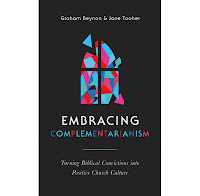
Complementarianism is the Christian teaching that men and women are significantly the same (in essence, worth, and salvation) and significantly different (in specific responsibilities and roles) and significantly need each other to become what God intended us to be. Women and men complement each other. This is true in both marriage and in ministry. This book focuses on the ministry of the church.
Most books on complementarianism spend a good bit of time arguing for the position and exploring the biblical basis for it (a good and much needed thing). Graham Beynon and Jane Tooher lay those things out briefly in a couple of the chapters but mostly assume that they are talking to those already-convinced who are looking for help in turning the concepts into reality. So it's not an argument but a guide. At the same time, they also don't turn it into a nuts-and-bolts manual. The authors don't tell you exactly what to do and what not to do. They help church leaders think through their approach and put their convictions into practice. Tooher and Beynon are from the UK and Australia and from different denominational structures. They recognize that complementarianism is going to look different in different contexts.
I really appreciated how the authors modeled a healthy complementarianism as they wrote together. The book is generous, careful, and thoughtful. There are no caricatures nor pretending or assuming that embracing complementarianism will be simple or easy to do in our current cultural context. But it's positive, as well. This work is worth doing and worth doing well. I can see Bible-believing churches using this book to good effect, maybe as a game-changer for some. It's also very well written and easy to read.
Extra: This morning right before finishing this post, I listened to an excellent podcast on the topic of complementarianism from the FIEC leaders conference in the UK: Different, Yet the Same: Is Complementarianism Unjust? by Linda Allcock. She also highly recommended Embracing Complementarianism as a key resource.
***
* As I’ve said before [2013, 2014, 2015, 2016, 20172018, 2020, 2021, 2022], this list is not necessarily the best books that were published that particular year or the most enjoyable either. I intend it to be a list of the fairly new Christian nonfiction books I read:
- that had the most personal impact on me, my thinking, my heart. - that I was the most consistently enthusiastic about. - that I kept coming back to again and again. - that I couldn't help recommending to others (and recommend without reservations and significant caveats).
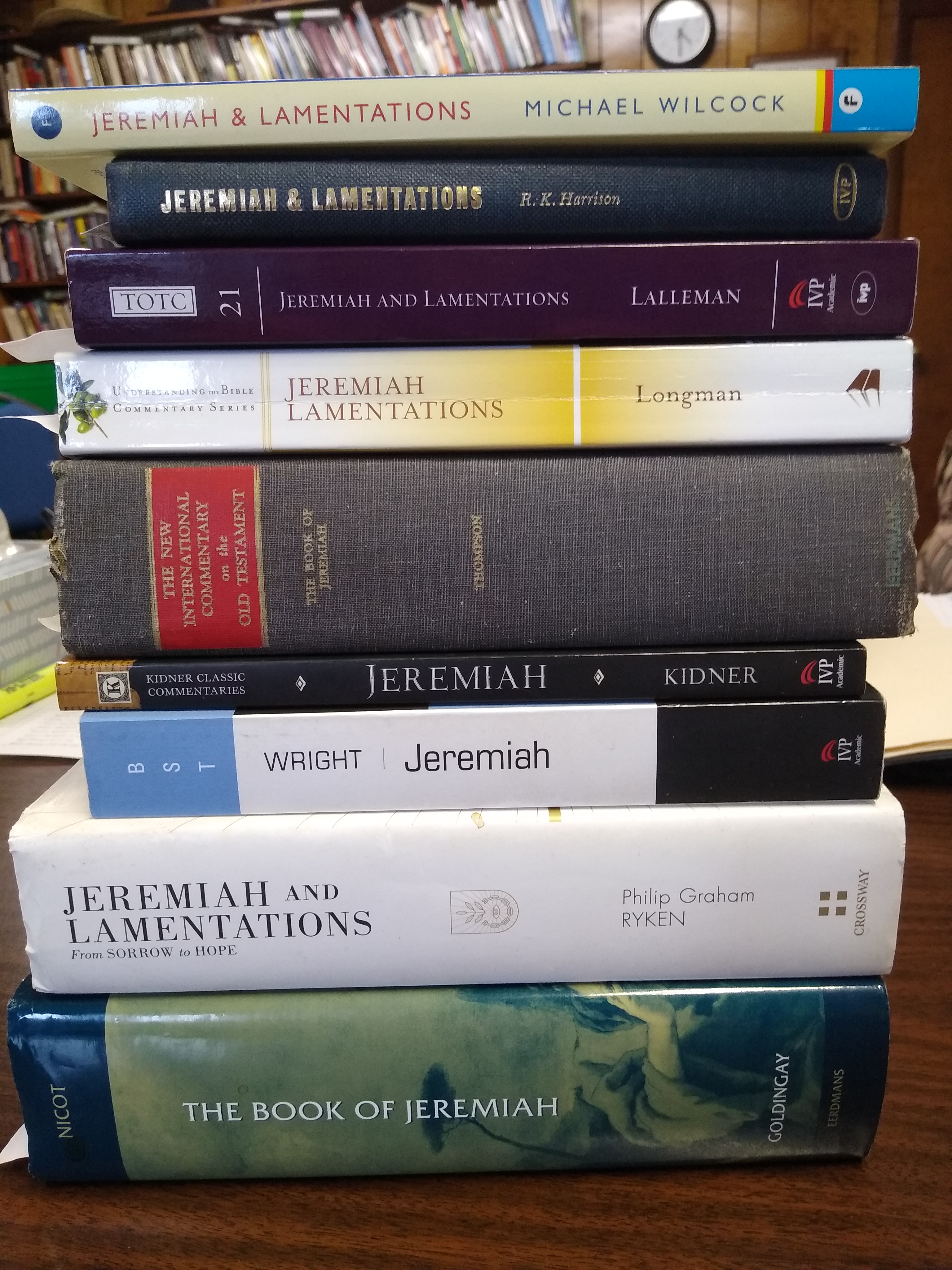
Over the last year, I had the great privilege and joy of preaching all the way through the Prophecy of Jeremiah for Lanse Free Church. Fifty-two chapters in thirty-six messages! I know that I couldn't have done it without the help of my friends--specifically the friendly scholars who write such helpful commentaries on the Words of Jeremiah. Here is are the best ones I read over the course of our series with a few notes about each one.
If I could only have one commentary on Jeremiah, Wright's is the one I would pick. I can't overestimate how helpful it was for understanding and even applying the sacred text. Even when I reached a conclusion before reading Wright's treatment of a passage, I was relieved to find out that my instincts were "right." It is imminently readable, judicious, insightful, scholarly, and pastoral. Highly highly recommended.
Goldingay has forgotten more than I'll ever know about Jeremiah. I'm glad his commentary came out a few months before I began my series. He proceeds from a few assumptions that I don't necessarily share (which leads at times to conclusions I don't share), but he's incredibly knowledgeable and perceptive. I learned from every page. I knew I needed this tome after I read his summary book The Theology of Jeremiah: The Book the Man, the Message which I also referenced every week using the scripture index to make sure I wasn't missing something important. Read with discernment, these are highly recommended resources.
When I read the introduction to Lalleman's commentary, I understood for the first time the importance of 1:10 and its themes, especially the idea of the coming uprooting that Jeremiah was to predict for Judah. Hence the title of our series: Uprooted - The Words of Jeremiah. Thank you, Hetty Lalleman! I don't know what the series would have been like without your help.
This compilation of Ryken's sermons on Jeremiah's books was invaluable to me, especially as a guide to application and homiletical delivery. I hope I gave Ryken credit for all of the turns-of-phrases I used that captured the thought so well. The original sermons are also available to listen to at The Gospel Coalition website.
Wilcock was great for giving a different perspective on passages (without seeming forced or changing the overarching message) and providing of the overviews of large sections together. I was amazed at how much he could pack into a few pages without seeming to be stuffing anything into anything. He also had interesting ideas about the composition of the text and why parts of Jeremiah are placed where they are--always an interesting question since Jeremiah jumps around so much chronologically!
As always, Kidner is concise, precise, and incisive. While C.J.H.Wright has replaced his commentary in the series (and surpassed it, too), Kidner is always worth reading (that's why Wright quotes him so often!).
Longman knows his Old Testament, and I'm always glad I read him. This one is more like the commentary notes at the bottom of a study Bible than a full commentary, but I don't know how many times, I found something there tidbit to ton that eventually made it into a message.
Thompson's commentary was the gold standard before Wright and Goldingay came along (Goldingay replaced Thompson's in the NICOT series), and it's obvious why. I'm glad I read every word.
I found this Bible study by Matthew S. Harmon at The Gospel Coalition to be really helpful, especially as an overview. I think that small groups would profit from using it over a twelve-week period.
Study Bibles
The best study Bibles out there have really helpful notes. I consulted these every single week: NIV Study Bible, NIV Biblical Theology Study Bible, ESV Study Bible, CSB Study Bible and the incredible translation notes at the NET Bible online.
One of the things I enjoyed the most about studying Jeremiah was getting to know Jeremiah the man. I have read his book many times but never felt like I knew him. Slowing down to read his words carefully and discuss him (at least in my head) with these amazing scholars gave me a much better sense of who he was as a person and what his painful message was for the people he loved. I hope I'm a better follower of the LORD because of it.
“So Judah Went Into Captivity, Away from Her Land”
Uprooted - The Words of Jeremiah
Lanse Evangelical Free Church
March 26, 2023 :: Jeremiah 52:1-34
The Book of Jeremiah does not have a happy ending.
It doesn’t get all sweetly tied up nicely with a bow on top and everybody living “happily ever after.” Feel-good boppy music playing in the background as the credits roll.
No. The Book of Jeremiah does not have a happy ending. But it does have a holy ending.
It shouldn’t be surprising to us by now. This has not been a happy book. For forty years, the Weeping Prophet Jeremiah has been a broken record about a broken covenant and the broken nation and the burnt city that would come of it. And we should not be surprised that the very last chapter is about that sad prophecy coming to pass.
The previous chapters (50 and 51) looked further ahead, down the road, when the wicked city of Babylon must fall. But first the wicked city of Jerusalem must fall. And fall, it did.
But we know that whenever the scripture repeats itself, what it’s saying a second time or a third time must be very important so we ought to pause and pay close attention.
What may be surprising about Jeremiah 52 is that it wasn’t written by Jeremiah. In fact, Jeremiah is never even mentioned. I said earlier that these were “The Words of Jeremiah Son of Hilkiah,” but that isn’t quite right. The Lord has included these words in Jeremiah’s book, but these are not his words. The last verse of the previous chapter said that the words of Jeremiah had ended there (51:64).
So the LORD has raised up another author to put this appendix(?), epilogue(?), post-script(?) historical addendum(?) onto the end of Jeremiah’s book to make sure that we get the point–Jeremiah’s prophecies have and will all come true.
Perhaps it was Baruch. Or maybe Baruch’s son because it really extends several years into the future. We don’t know who wrote it, but we do know that He was inspired by the LORD to include it with the Words of Jeremiah to be for us the Word of God.
Let’s look at it together. And as we do, I want to point out three things about the LORD that we can confidently say because we’ve read all of Jeremiah, but especially this chapter. And then apply those three things to our lives today.
Jeremiah chapter 52, verse 1. The story backs up to 597 BC and the beginning of the reign of the last king of Judah. Verse 1.
“Zedekiah was twenty-one years old when he became king, and he reigned in Jerusalem eleven years. His mother's name was Hamutal daughter of Jeremiah; she was from Libnah. He did evil in the eyes of the LORD, just as Jehoiakim had done. It was because of the LORD's anger that all this happened to Jerusalem and Judah, and in the end he thrust them from his presence” (vv.1-3).
We’ve learned a lot about Zedekiah in the last few months. He was a thumbs-down king, just like every king was ever since his father Josiah died. His brother Jehoiakim had been a terrible thumb-down king. He was the one who burned the scroll of Jeremiah.
And Zedekiah wasn’t like that, but he never was holy. He would ask for advice. He would seek counsel from the prophet, but he would never do what the prophet said God wanted him to do. And eventually it caught up with him. And the whole nation went down. And they went into exile. The LORD “thrust them from his presence” (v.3). What scary words are those?!
#1. THE LORD’S ANGER IS HOLY.
We see in verse 3 that the LORD was angry, and that is scary, because the LORD is God! He is omnipotent and sovereign, so when He gets angry, terrible things may happen. But His anger is not capricious or moody or impulsive. He never gets up on the wrong side of the bed. When He is angry, it’s about something worth being angry about. The LORD’S anger is holy. Look at verse 2 again.
“[Zedekiah] did evil in the eyes of the LORD, just as Jehoiakim had done. It was because of the LORD's anger that all this happened to Jerusalem and Judah, and in the end he thrust them from his presence” (vv.2-3).
Everything terrible thing we’re going to read about that God does here is perfectly just and right and righteous and holy. The kings and the people broke the covenant. They worshiped other gods. They did evil in the eyes of the LORD, the holy eyes of the LORD. No wonder the judgment fell.
We live in a day when holiness seems silly and unimportant. Holiness seems trite and trivial and foreign to our ears. Nobody cares about being holy. Everybody cares about being happy, but few care about being holy. God cares about being holy. He is holy, holy, holy. And He wants us to be holy, too.
We live in a time when people think, “I’m not so bad, and God’s not so mad.” But the fact is that we are bad, and God is mad, and God’s anger is holy.
That’s why the Cross, right? The Cross is about God’s love for us, yes, but it’s also about God’s holiness, right? We have been unholy, and so we needed Jesus to do what He did on the Cross to make us holy once more. “God made him who had no sin to be sin for us, so that in him we might become the righteousness of God” (2 Cor. 5:21 NIVO). That’s what was going on at the Cross. What we are heading into celebrating the next few weeks.
“He himself bore our sins in his body on the tree, so that we might die to sins and live for righteousness (holiness); by his wounds you have been healed. For you were like sheep going astray (unholy), but now you have returned to the Shepherd and Overseer of your souls (holy once more)” (1 Pet. 2:24-25 NIVO).
His anger is holy, and that’s why Jesus died like He did. And that allows us now to live a holy life ourselves.
I hope that studying the prophecy of Jeremiah has helped us to cultivate a hatred of our sin and love for God’s holiness. When we see how seriously God feels about idolatry and pride and wickedness, and the lengths He went to save us from those things, I hope that we have been led into repentance from our hearts. We can learn from the errors of Judah. What sins are you repenting of, what idols are you smashing, what areas of holiness are you growing in?
The LORD says, “Be holy as I am holy.” And we see here just how holy He is. He was so holy that He demolished His favorite city on Earth. V.3 once more.
“Now Zedekiah rebelled against the king of Babylon. So in the ninth year of Zedekiah's reign, on the tenth day of the tenth month, Nebuchadnezzar king of Babylon marched against Jerusalem with his whole army. They camped outside the city and built siege works all around it. The city was kept under siege until the eleventh year of King Zedekiah. [About 18 months.] By the ninth day of the fourth month [Janaury 15, 588BC] the famine in the city had become so severe that there was no food for the people to eat.
Then the city wall was broken through, and the whole army fled. They left the city at night through the gate between the two walls near the king's garden, though the Babylonians were surrounding the city. They fled toward the Arabah, but the Babylonian army pursued King Zedekiah and overtook him in the plains of Jericho. All his soldiers were separated from him and scattered, and he was captured. He was taken to the king of Babylon at Riblah in the land of Hamath, where he pronounced sentence on him.
There at Riblah the king of Babylon slaughtered the sons of Zedekiah before his eyes; he also killed all the officials of Judah. Then he put out Zedekiah's eyes, bound him with bronze shackles and took him to Babylon, where he put him in prison till the day of his death” (vv.3-11).
Like I said, the Book of Jeremiah does not have a happy ending, but it does have a holy ending. And it also has an honest ending. This is what truly happened, and what Jeremiah had said would happen, came true.
#2. THE LORD’S WORD IS TRUE.
Listen to Jeremiah 32, verse 4. “Zedekiah king of Judah will not escape out of the hands of the Babylonians but will certainly be handed over to the king of Babylon, and will speak with him face to face and see him with his own eyes” (Jer. 32:4).
And that’s exactly what happened. Nebuchadnezzar was, in fact, the last thing Zedekiah saw. Nebuchadnezzar killing his sons. The end of the line, both figuratively and literally.
In Jeremiah 34:3-4, the LORD says to Jeremiah, “Go to Zedekiah king of Judah and tell him, 'This is what the LORD says: I am about to hand this city over to the king of Babylon, and he will burn it down. You will not escape from his grasp but will surely be captured and handed over to him. You will see the king of Babylon with your own eyes, and he will speak with you face to face. And you will go to Babylon” (Jer. 34:2-3).
Everything Jeremiah said would happen is exactly what happened. The LORD’s word was true. All of those other prophets were false. They were full of lies. But Jeremiah’s mouth was full of truth.
The lies sounded so good. We want to believe the lies, but we must believe the truth. And the truth was that the city was going to fall. Verse 12.
“On the tenth day of the fifth month, in the nineteenth year of Nebuchadnezzar king of Babylon, Nebuzaradan commander of the imperial guard, who served the king of Babylon, came to Jerusalem. He set fire to the temple of the LORD, the royal palace and all the houses of Jerusalem. Every important building he burned down. The whole Babylonian army under the commander of the imperial guard broke down all the walls around Jerusalem” (vv.12-14).
If you want to know how this felt, read the next book of the Bible, the Book of Lamentations. It felt to them like the end of the world. And was the fulfillment of the word of the LORD.
The LORD said to Jeremiah, “Now, I have put my words in your mouth. See, today I appoint you over nations and kingdoms to uproot and...TEAR DOWN [same words in Hebrew as v.14], to destroy and overthrow, to build and to plant” (Jer. 1:9-10).
The Babylonians systematically tore down the walls around Jerusalem until the walls were completely dismantled and the city demolished. And, just as promised, the people were taken into exile. V.15
“Nebuzaradan the commander of the guard carried into exile some of the poorest people and those who remained in the city, along with the rest of the craftsmen and those who had gone over to the king of Babylon. [Apparently they needed some workers.] But Nebuzaradan left behind the rest of the poorest people of the land to work the vineyards and fields” (vv.15-16).
And then they went after the temple of the LORD. Verse 17.
“The Babylonians broke up the bronze pillars, the movable stands and the bronze Sea that were at the temple of the LORD and they carried all the bronze to Babylon. [Let the looting begin!] They also took away the pots, shovels, wick trimmers, sprinkling bowls, dishes and all the bronze articles used in the temple service.
The commander of the imperial guard took away the basins, censers, sprinkling bowls, pots, lampstands, dishes and bowls used for drink offerings–all that were made of pure gold or silver. The bronze from the two pillars, the Sea and the twelve bronze bulls under it, and the movable stands, which King Solomon had made for the temple of the LORD, was more than could be weighed[!]. Each of the pillars was eighteen cubits high and twelve cubits in circumference; each was four fingers thick, and hollow. The bronze capital on top of the one pillar was five cubits high and was decorated with a network and pomegranates of bronze all around. The other pillar, with its pomegranates, was similar. There were ninety-six pomegranates on the sides; the total number of pomegranates above the surrounding network was a hundred” (vv.17-23).
Do you remember the beauty of the temple of the LORD?
Solomon’s glorious temple with all of its gold, and silver, and bronze?
All of these things were described as they were put up in 1 Kings 6, 7, and 8, and now they are inventoried as they are stolen away in Jeremiah 52. And the entire time that the exiles are in Babylon, they are stored away in the treasury of the Babylonians.
Just like Jeremiah (and Micah before him) had said. “Zion will be plowed like a field, Jerusalem will become a heap of rubble, the temple hill a mound overgrown with thickets” (Jeremiah 26:18).
But, keep this in mind, these items were inventoried and kept. The ones that weren’t smashed up were stored away, and there will actually be a future for them! There’s a glimmer here of hope. Even as, in His holiness, the LORD is bringing judgment on His temple. But how depressing it must have been to see those precious items stolen away and the temple of the LORD, the temple of LORD, the temple of the LORD torn down.
And the leaders of Judah killed. Verse 24. “The commander of the guard took as prisoners Seraiah the chief priest, Zephaniah the priest next in rank and the three doorkeepers. Of those still in the city, he took the officer in charge of the fighting men, and seven royal advisers. He also took the secretary who was chief officer in charge of conscripting the people of the land and sixty of his men who were found in the city. Nebuzaradan the commander took them all and brought them to the king of Babylon at Riblah. There at Riblah, in the land of Hamath [modern day Syria], the king had them executed. So Judah went into captivity, away from her land” (vv.24-28).
That’s our sermon title for today. And it reminds us that this is all going according to plan. These terrible things are all God’s holy threats come true. Including the exile. This is not a mistake. This does not take God by surprise. It is, in fact, the judgment of God. For forty years, Jeremiah has been saying that Judah will go into captivity.
Judah will go into captivity.
Judah will go into captivity.
“So [v.28] Judah went into captivity, away from her land.”
The LORD is faithful to keep His promises, including His threats. And He’s been threatening this for more forty years. He’s been saying that this would come since the book of Deuteronomy. If they did not repent, they would be thrust out of the land.
Verses 28 through 30 give some stats on that. “This is the number of the people Nebuchadnezzar carried into exile: in the seventh year, 3,023 Jews; in Nebuchadnezzar's eighteenth year, 832 people from Jerusalem; in his twenty-third year, 745 Jews taken into exile by Nebuzaradan the commander of the imperial guard. There were 4,600 people in all” (vv.28-30). In those three particular deportations. There was one before it and probably others. And those numbers are probably just the men or even just the leaders. The full count was probably much higher and doesn’t include all of those died in the process.
Babylon has won. Judah has lost. Just as the LORD has said.
You know what this chapter is kind of like? It’s like the post-credit scenes in a modern movie. These days if you go to a movie in the theatre, you don’t get up until after the credits are all over. I’ve made the mistake of leaving before they’re all done. Because a lot of movies, especially the super-hero ones I like, have these extra scenes that take place in the middle of or after the credits that kind of tell the rest of the story or set things up for the next movie.
“Jeremiah the movie” is over, but here’s these scenes that show us that everything that Jeremiah predicted came true. Jeremiah is vindicated as a true prophet. In these scenes, we watch Jerusalem be besieged. We see the walls be breached. We see Zedekiah have to watch his sons die. We see his eyes come out. We watch the walls of Jerusalem be torn down. We watch the temple things be stolen before our very eyes. We see the city burn. We watch the leaders be executed at Riblah. We watch the waves of thousands of Jewish people go into captivity in Babylon. Just like Jeremiah said. Do you see it?
The Word of the LORD is true. Every single word. Do you trust what you read in here? Do you know what it says? Do you believe it? The LORD will keep every one of His promises, including His threats.
I hope that studying the Book of Jeremiah this last year has put some steel in backbones to stand with the word of God no matter what.
On Friday, Joel Michaels and I went up near Rochester for an ordination council of a new pastor in our district. Pastor Jake Buss. And it was so encouraging to hear Jake explain the Word of God and what he believes about it and how he stakes his life on it.
This book doesn’t always say what I want it to say! But it says what I need it to say. And it says what is true. And for those who belong to Jesus, it also always says a word of hope.
The book of Jeremiah does not have a happy ending, but it does have a hopeful ending.
There’s a hint of hope, at least. For one, we know that Babylon does not win forever. They may be the winners at end of chapter 52, but we just read chapters 50 and 51 last week, and we know that Babylon must fall. And when it does, God’s people will rejoice.
And we know that those golden things from the temple are going to show up again, and the temple is going to return. This afternoon, you might want to read the book of Ezra, chapter 1. All those things from verses 17 through 23 make the trip back from Babylon to Jerusalem! And get used again!
But the hope is bigger than that. It’s not just in a temple that will be destroyed yet again in the first century AD. The hope that we really look forward to is that a son of David will be king forever. And there is a little hint of that in the last four verses of the chapter 52. Look at verse 31.
“In the thirty-seventh year of the exile of Jehoiachin king of Judah, in the year Evil-Merodach became king of Babylon [Nebuchadnezzar’s son, 561BC], he released Jehoiachin king of Judah and freed him from prison on the twenty-fifth day of the twelfth month.
He spoke kindly to him and gave him a seat of honor higher than those of the other kings who were with him in Babylon. So Jehoiachin put aside his prison clothes and for the rest of his life ate regularly at the king's table. Day by day the king of Babylon gave Jehoiachin a regular allowance as long as he lived, till the day of his death” (vv.31-34).
Now, that’s not a happy ending.
Jehoiachin was only king in Judah for 3 short months. And then he spent 37 years[!] in prison in exile. He never made it back to Judah. And none of his seven sons became king either. He lived to see thousands of his kinsmen captive with him and having to live year after year in Babylon. He probably saw his eyeless uncle Zedekiah hauled into the prison with him to live out his days.
This was not a happy ending.
But it was a hopeful one. This last post-credit scene has the new king of Babylon come in and invite Jehoiachin to sit at his table as a fellow king. To change his clothes and act like a king again, till the day of his death. We don’t know when that was.
There are no words in this last post-credit scene. There’s no quotation marks. We just see the old man change clothes, put on royal robes and eat royal food.
And we think, “Oh, oh, I know what’s going to happen in the next movie!”
Not only will Babylon fall because God said it would.
Not only will the temple return because God makes a way for it.
But God has promised that a son of David will arise.
Wicked Zedekiah was NOT the end of the line!
God said it in this book. Jeremiah chapter 23, “‘The days are coming,’ declares the LORD, ‘when I will raise up to David a righteous Branch, a King who will reign wisely and do what is just and right in the land. In his days Judah will be saved and Israel will live in safety. This is the name by which he will be called: The LORD Our Righteousness’” (Jer. 23:5-6 NIVO).
And we know another name for Him.
We find it in the Gospel of Matthew chapter 1 where it says, “After the exile to Babylon: Jeconiah [which was another name for Jehoiachin] was the father of Shealtiel, Shealtiel the father of Zerubbabel, Zerubbabel the father of Abiud, Abiud the father of Eliakim, Eliakim the father of Azor, Azor the father of Zadok, Zadok the father of Akim, Akim the father of Eliud, Eliud the father of Eleazar, Eleazar the father of Matthan, Matthan the father of Jacob, and Jacob the father of Joseph, the husband of Mary, of whom was born Jesus, who is called Christ” (Matt. 1:12-16 NIVO).
This scene is setting us up for that story still to come!
#3. THE LORD’S GRACE IS AMAZING!
After all of this righteous judgment and just condemnation, after all of this holy anger poured out, God still has a plan to bless His people with His grace! God will send His Son from the line of this king in exile[!] to make every good promise He has ever made come true.
Baruch’s brother Seraiah tied these two chapters of Jeremiah to a rock and tossed them into the Euphrates river.
Do you know this story? To understand these two chapters, it helps to start at the end.
It turns out that Jeremiah sent a copy of the main contents of these two chapters, Jeremiah 50 and 51, all the way to Babylon with Seraiah son of Neriah, who was probably his assistant Baruch’s brother. And Jeremiah sent a copy of these two chapters all the way to Babylon with Seraiah when King Zedekiah had to go there in 593 BC. And Jeremiah told Seraiah to read the words of the prophecies out loud. And then pray that God would fulfill them and then tie the scroll to a stone and throw the whole thing into the river with a big splash!
I love it that Jeremiah is at it again with his dramatic symbolic acts! He’s got yet even one more of these prophetic props up his sleeve at the very end of his book. This one by remote! Jeremiah isn’t even there, but he’s telling Seraiah what to do. Seraiah is supposed to tie these words to a rock and let it sink into the Euphrates. And then what?
Now, this drowning of the scroll is the opposite of when Jehoiakim burnt the scroll. That was somehow trying to keep the prophecy from coming true and showing disdain and contempt for the Word of God. And trying to destroy the Word of God. This was actually part of the Word of God. This was the Word of God being fulfilled. Enacting the Word of God.
Because what these words said were that “Babylon Must Fall.” That’s our sermon title for today taken from verse 49 of chapter 51. “Babylon Must Fall.” Like this scroll hitting the bottom of the Euphrates, the kingdom of Babylon must sink down to rise no more.
Last week, we read about God’s judgment coming on nine different nations. The LORD’s prophecies “concerning the nations” that surrounded Judah. Sometimes their allies, but more often than not, their enemies. Starting with Egypt in the South and West, the prophecies curled around Judah heading East and North.
What do you think we’re going see when we read them? The people of Judah would have been very interested to hear what the LORD had to say was going to happen to Babylon. They didn’t like to hear what Jeremiah had to say about what was going to happen to them. They tried to ignore him for 40 years about that! But they would have cocked an ear and listened with interest to find out what Yahweh prophesied to Babylon. What kind of things do you think He’s going to say?
A lot of it is just like what we saw last week. There is a lot of justice. There is a lot of judgment and vengeance and punishment. Remember “the sword” from last week? “The sword of the LORD.” That sword is going to come out swinging through these two chapters as “Babylon Must Fall.”
We’re also going to see the LORD shaming the false gods. Yahweh alone is God, and He will brook no rivals. The gods of Babylon will be shamed and defeated and disgraced.
We’re also, once again, going to see the LORD humbling the arrogant. No kingdom had ever been as prideful as Babylon! Therefore no kingdom would ever be as humbled.
And along the way, we’ll also see the LORD rescuing His people and giving them rest from their enemies. These chapters are heavy if you are the people of Babylon, but they are delightful if you are people of Judah! The people of Judah would have just rejoiced to hear these things. They would have cried tears of joy.
And maybe of disbelief. It might have been very hard for them to believe these prophecies. They sounded too good to be true! Nothing in these prophesies seemed very likely at the time. Babylon was at the heights of power in the whole entire world! But the LORD said that Babylon must fall.
Let’s just read our way through it and see what’s there, and then when we get to the end, I’ll have 3 points of application for our lives today.
Jeremiah chapter 50, verse 1.
“This is the word the LORD spoke through Jeremiah the prophet concerning Babylon and the land of the Babylonians:”
[By the way, your Bible may say “Chaldea” and the “Chaldeans.” That’s how the Hebrew actually reads. The Chaldeans were the ethnic group that had risen to rule Babylon at this moment starting with Nabopolassar and his son Nebuchadnezzar. They were the Chaldeans who were ruling Babylon, and so to keep things simple, many English Bibles uses “Babylon” and “Babylonia” in those verses to keep things straight. Back to verse 1.]
“This is the word the LORD spoke through Jeremiah the prophet concerning Babylon and the land of the Babylonians: ‘Announce and proclaim among the nations, lift up a banner and proclaim it; keep nothing back, but say, 'Babylon will be captured; Bel will be put to shame, Marduk filled with terror. Her images will be put to shame and her idols filled with terror.'
A nation from the north will attack her and lay waste her land. No one will live in it; both men and animals will flee away” (vv.1-3).
This is something that Judah has longed to hear for a very long time. Babylon is going to be captured. All they’ve heard year after year is that Judah is going to be captured. But the LORD says that after that Babylon is going to get it, too. And it’s going to be an enemy from the north that does it!
And you see what’s going to happen to their gods? That’s who Bel is (it’s like Baal) and Marduk also known as “Merodach.” That’s the chief god of Babylon. He’s going to be shamed and scared! I love that picture. Babylon’s gods are going to be terrified and helpless to stop the LORD from judging them. At long last!
And, at long last, there will finally be real repentance among the people of Judah. Look at verse 4.
“‘In those days, at that time,’ declares the LORD, ‘the people of Israel and the people of Judah together will go in tears to seek the LORD their God. They will ask the way to Zion and turn their faces toward it. They will come and bind themselves to the LORD in an everlasting covenant that will not be forgotten” (vv.4-5).
This is just like the promises of chapters 30 through 33. Promises of restoration and the new permanent covenant written on their hearts! At long last. V.6
“My people have been lost sheep; their shepherds have led them astray and caused them to roam on the mountains. They wandered over mountain and hill and forgot their own resting place. [Bad kings.] Whoever found them devoured them; their enemies said, 'We are not guilty, for they sinned against the LORD, their true pasture, the LORD, the hope of their fathers.'”
The people who had conquered Judah were right that Judah deserved their punishment. But that did not mean that they were right to conquer them. They were oppressors, and when the LORD was done using them to judge His people, He was going to judge them! Babylon must fall.
So Judah must flee. V.8
“‘Flee out of Babylon; leave the land of the Babylonians, and be like the goats that lead the flock. For I will stir up and bring against Babylon an alliance of great nations from the land of the north. They will take up their positions against her, and from the north she will be captured. Their arrows will be like skilled warriors who do not return empty-handed. So Babylonia will be plundered; all who plunder her will have their fill,’ declares the LORD.” (Vv.8-11).
Now, this command to “flee” is interesting. It’s not something that Judah is supposed to do right away. In chapter 29, in the letter to the exiles, written perhaps at the very same time[!], the LORD told them to settle down and build houses and pray for the peace and prosperity of Babylon for the time being.
But only for the time being. When the seventy years of their sentence is up, they are supposed to get out of Dodge. Settle in but don’t get too comfortable. Because Babylon must fall.
Why must they fall? Why must this “alliance of nations” rise up from the north to plunder them? Because of how they have treated God’s people! V.11 The LORD says:
“‘Because you rejoice and are glad, you who pillage my inheritance, because you frolic like a heifer threshing grain and neigh like stallions, your mother will be greatly ashamed; she who gave you birth will be disgraced. She will be the least of the nations–a wilderness, a dry land, a desert. Because of the LORD's anger she will not be inhabited but will be completely desolate. All who pass Babylon will be horrified and scoff because of all her wounds” (vv.11-13).
Do you see how this is justice? Babylon has done wrong against God’s people, and they will not get away with it. There will be blood. V.14
“‘Take up your positions around Babylon, all you who draw the bow. Shoot at her! Spare no arrows, for she has sinned against the LORD. Shout against her on every side! She surrenders, her towers fall, her walls are torn down. Since this is the vengeance of the LORD, take vengeance on her; do to her as she has done to others.”
That’s justice. And at the same time, it’s salvation–for God’s people. V.16
“Cut off from Babylon the sower, and the reaper with his sickle at harvest. Because of the sword of the oppressor [Babylon] let everyone return to his own people, let everyone flee to his own land.
‘Israel is a scattered flock that lions have chased away. The first to devour him was the king of Assyria [in the northern kingdom]; the last to crush his bones was Nebuchadnezzar king of Babylon’ [in the south]. Therefore this is what the LORD Almighty, the God of Israel, says: ‘I will punish the king of Babylon and his land as I punished the king of Assyria.
But I will bring Israel back to his own pasture and he will graze on Carmel and Bashan; his appetite will be satisfied on the hills of Ephraim and Gilead” (vv.16-19).
The Savior will “like a Shepherd lead us, [so] much we need [His] tender care. In [His] pleasant pastures feed us, For our use [His] folds prepare[d].” - Dorothy Thrupp
This justice on God’s enemies means salvation for God’s people.
Total salvation. Including total forgiveness! Look at verse 20.
“In those days, at that time,’ declares the LORD, ‘search will be made for Israel's guilt [and there was so much of it! We have seen so much of it], but there will be none, and for the sins of Judah [and there was so much of it!], but none will be found, for I will forgive the remnant I spare” (v.20).
You and I know how that is even possible! It’s because of what Jesus Christ did at Calvary.
“You laid down Your life
That I would be set free”
Oh, Jesus, I sing for
All that You've done for me
Worthy is the Lamb who was slain!” (Phil Wickham)
They will search for our guilt and our sins, but none will be found! That’s why we have a hope and future
But Babylon does not have a hope or a future. V.21
“‘Attack the land of Merathaim and those who live in Pekod. Pursue, kill and completely destroy them,’ declares the LORD. ‘Do everything I have commanded you. The noise of battle is in the land, the noise of great destruction! How broken and shattered is the hammer of the whole earth! How desolate is Babylon among the nations!
I set a trap for you, O Babylon, and you were caught before you knew it; you were found and captured because you opposed the LORD. The LORD has opened his arsenal and brought out the weapons of his wrath, for the Sovereign LORD Almighty has work to do in the land of the Babylonians.
Come against her from afar. Break open her granaries; pile her up like heaps of grain. Completely destroy her and leave her no remnant. Kill all her young bulls; let them go down to the slaughter! Woe to them! For their day has come, the time for them to be punished.
Listen to the fugitives and refugees from Babylon declaring in Zion how the LORD our God has taken vengeance, vengeance for his temple” (vv.21-28).
He doesn’t stop, does He? Babylon thinks of themselves as “the hammer of the whole earth.” They can pound wherever they want. They can pound whoever they want. But now the those who have been doing the pounding are going to get the pounding.
And, make no mistake, it is the LORD who is now doing the pounding! V.29
“‘Summon archers against Babylon, all those who draw the bow. Encamp all around her; let no one escape. Repay her for her deeds; do to her as she has done. For she has defied the LORD, the Holy One of Israel. Therefore, her young men will fall in the streets; all her soldiers will be silenced in that day,’ declares the LORD.
‘See, I am against you, O arrogant one,’ declares the Lord, the LORD Almighty, ‘for your day has come, the time for you to be punished. The arrogant one will stumble and fall and no one will help her up; I will kindle a fire in her towns that will consume all who are around her’” (vv.29-32).
There’s that theme of humbling the prideful, isn’t there? Don’t raise yourself up. Humble yourself and let the LORD do it. Babylon was so arrogant, and so Babylon must fall. V.33
“This is what the LORD Almighty says: ‘The people of Israel are oppressed, and the people of Judah as well. All their captors hold them fast, refusing to let them go.
Yet their Redeemer is strong; the LORD Almighty is his name. He will vigorously defend their cause so that he may bring rest to their land, but unrest to those who live in Babylon.
[Salvation by “the sword.” V.35]
‘A sword against the Babylonians!’ declares the LORD– ‘against those who live in Babylon and against her officials and wise men! A sword against her false prophets! They will become fools. A sword against her warriors! They will be filled with terror. A sword against her horses and chariots and all the foreigners in her ranks! They will become women. A sword against her treasures! They will be plundered. A drought on her waters! They will dry up. For it is a land of idols, idols that will go mad with terror.
‘So desert creatures and hyenas will live there, and there the owl will dwell. It will never again be inhabited or lived in from generation to generation. As God overthrew Sodom and Gomorrah along with their neighboring towns,’ declares the LORD, ‘so no one will live there; no man will dwell in it.
‘Look! An army is coming from the north; a great nation and many kings are being stirred up from the ends of the earth. They are armed with bows and spears; they are cruel and without mercy. They sound like the roaring sea as they ride on their horses; they come like men in battle formation to attack you, O Daughter of Babylon” (vv.33-44).
A sword, a sword, a sword, a sword. If you don’t have room in your concept of God for the sword of the LORD, you need to learn to make room for the justice of God. Babylon must fall. And so it will. V.43
“The king of Babylon has heard reports about them [the attacking armies], and his hands hang limp. Anguish has gripped him, pain like that of a woman in labor. [This actually happened to king Belshazzer in Daniel chapter 5!] Like a lion coming up from Jordan's thickets to a rich pastureland, I will chase Babylon from its land in an instant. Who is the chosen one I will appoint for this? Who is like me and who can challenge me? And what shepherd can stand against me?’ Therefore, hear what the LORD has planned against Babylon, what he has purposed against the land of the Babylonians: The young of the flock will be dragged away; he will completely destroy their pasture because of them. At the sound of Babylon's capture the earth will tremble; its cry will resound among the nations.”
Babylon will fall.
Imagine being an Israelite in exile and hearing this prophecy from the pen of Jeremiah. You’ve been told that Jerusalem is going to fall. And here you are living your life in Babylon, among your captors and oppressors.
And then you hear that justice is coming. They are going to get what is coming to them. And then you hear more about it in chapter 51:
“This is what the LORD says: ‘See, I will stir up the spirit of a destroyer against Babylon and the people of Leb Kamai. [That’s a play on words. A cryptogram for Chaldea that also means “The Heart of My Attackers.” The LORD is attacking them. V.2] I will send foreigners to Babylon to winnow her and to devastate her land; they will oppose her on every side in the day of her disaster.
Let not the archer string his bow, nor let him put on his armor. Do not spare her young men; completely destroy her army. They will fall down slain in Babylon, fatally wounded in her streets. [Why?] For Israel and Judah have not been forsaken by their God, the LORD Almighty, though their land is full of guilt before the Holy One of Israel. [He’s going to save them in spite of their sins!]
‘Flee from Babylon! Run for your lives! Do not be destroyed because of her sins. It is time for the LORD's vengeance; he will pay her what she deserves” (vv.1-6).
There’s that call to flee again. When the seventy years are up, they are supposed to pick up their stuff and run out of Babylon like their lives depended on it. Because they did! Because Babylon must fall.
Verse 7. “Babylon was a gold cup in the LORD's hand; she made the whole earth drunk. The nations drank her wine; therefore they have now gone mad. Babylon will suddenly fall and be broken. Wail over her! Get balm for her pain; perhaps she can be healed. 'We would have healed Babylon, but she cannot be healed; let us leave her and each go to his own land, for her judgment reaches to the skies, it rises as high as the clouds.'
'The LORD has vindicated us; come, let us tell in Zion what the LORD our God has done.'”
There’s that salvation theme again. This judgment of God’s enemies means the salvation of God’s people. V.11
“‘Sharpen the arrows, take up the shields! The LORD has stirred up the kings of the Medes, because his purpose is to destroy Babylon. The LORD will take vengeance, vengeance for his temple. Lift up a banner against the walls of Babylon! Reinforce the guard, station the watchmen, prepare an ambush! The LORD will carry out his purpose, his decree against the people of Babylon.
You who live by many waters and are rich in treasures, your end has come, the time for you to be cut off. The LORD Almighty has sworn by himself: I will surely fill you with men, as with a swarm of locusts, and they will shout in triumph over you.
‘He made the earth by his power; he founded the world by his wisdom and stretched out the heavens by his understanding. When he thunders, the waters in the heavens roar; he makes clouds rise from the ends of the earth. He sends lightning with the rain and brings out the wind from his storehouses. ‘Every man is senseless and without knowledge; every goldsmith is shamed by his idols. His images are a fraud; they have no breath in them. They are worthless, the objects of mockery; when their judgment comes, they will perish. He who is the Portion of Jacob is not like these, for he is the Maker of all things, including the tribe of his inheritance–the LORD Almighty is his name” (vv.11-20).
In this section, the LORD finally names the next major world power that is going to take down Babylon. It will be the Medes. We’ll learn later that it will be the Medes and the Persians together. It will take a massive alliance of nations to conquer Babylon, but it will happen.
They are coming from the north like a swarm of locusts. However, they aren’t the real power that will make Babylon fall. That will be the LORD Himself, the only real and true God.
These words in verses 15-19 were used before in chapter 10. The LORD cut and pasted them from chapter 10 when He was going to judge Judah. The very same real God (unlike the shameful fake gods, the very same real God) will now judge Babylon.
Babylon has been used by God but not excused by God. Verse 20.
“‘You are my war club, my weapon for battle–with you I shatter nations, with you I destroy kingdoms, with you I shatter horse and rider, with you I shatter chariot and driver, with you I shatter man and woman, with you I shatter old man and youth, with you I shatter young man and maiden, with you I shatter shepherd and flock, with you I shatter farmer and oxen, with you I shatter governors and officials” (vv-20-23).
How’s that for repetition? I’m not sure who the war club is here. Half of me thinks it’s Cyrus, the king of the Persians who is going to make Babylon fall. But the other half of me thinks it’s talking about Babylon itself and how God used Babylon but didn’t excuse Babylon. God used them to bring His righteous justice through their unrighteous oppression. Either way, now He’s going to bring them down. V.24
“‘Before your eyes I will repay Babylon and all who live in Babylonia for all the wrong they have done in Zion,’ declares the LORD. ‘I am against you, O destroying mountain, you who destroy the whole earth,’ declares the LORD. ‘I will stretch out my hand against you, roll you off the cliffs, and make you a burned-out mountain. No rock will be taken from you for a cornerstone, nor any stone for a foundation, for you will be desolate forever,’ declares the LORD.
‘Lift up a banner in the land! Blow the trumpet among the nations! Prepare the nations for battle against her; summon against her these kingdoms: Ararat, Minni and Ashkenaz. [Territories of the Medes.] Appoint a commander against her; send up horses like a swarm of locusts. Prepare the nations for battle against her–the kings of the Medes, their governors and all their officials, and all the countries they rule.
The land trembles and writhes, for the LORD's purposes against Babylon stand–to lay waste the land of Babylon so that no one will live there.
Babylon's warriors have stopped fighting; they remain in their strongholds. Their strength is exhausted; they have become like women. Her dwellings are set on fire; the bars of her gates are broken. One courier follows another and messenger follows messenger to announce to the king of Babylon that his entire city is captured, the river crossings seized, the marshes set on fire, and the soldiers terrified’” (vv.24-32).
He doesn’t stop, does He? He has one big message, and He wants us to get it. V.33
“This is what the LORD Almighty, the God of Israel, says: ‘The Daughter of Babylon is like a threshing floor at the time it is trampled; the time to harvest her will soon come.’ ‘Nebuchadnezzar king of Babylon has devoured us, he has thrown us into confusion, he has made us an empty jar. Like a serpent he has swallowed us and filled his stomach with our delicacies, and then has spewed us out.
May the violence done to our flesh be upon Babylon,’ say the inhabitants of Zion. ‘May our blood be on those who live in Babylonia,’ says Jerusalem” (vv.33-35).
We see here, at last, not just real repentance and real rest and real redemption for Judah, but we see, at last, real retribution for Babylon. V.36
“Therefore, this is what the LORD says: ‘See, I will defend your cause and avenge you [Judah]; I will dry up her sea and make her springs dry. Babylon will be a heap of ruins, a haunt of jackals, an object of horror and scorn, a place where no one lives. Her people all roar like young lions, they growl like lion cubs. But while they are aroused, I will set out a feast for them and make them drunk, so that they shout with laughter–then sleep forever and not awake,’ declares the LORD. ‘I will bring them down like lambs to the slaughter, like rams and goats. ‘How Sheshach will be captured, the boast of the whole earth seized! What a horror Babylon will be among the nations! The sea will rise over Babylon; its roaring waves will cover her. Her towns will be desolate, a dry and desert land, a land where no one lives, through which no man travels.
I will punish Bel in Babylon and make him spew out what he has swallowed. The nations will no longer stream to him. And the wall of Babylon will fall.”
“‘Come out of her, my people! Run for your lives! Run from the fierce anger of the LORD. Do not lose heart or be afraid when rumors are heard in the land; one rumor comes this year, another the next, rumors of violence in the land and of ruler against ruler. For the time will surely come when I will punish the idols of Babylon; her whole land will be disgraced and her slain will all lie fallen within her.
Then heaven and earth and all that is in them will shout for joy over Babylon, for out of the north destroyers will attack her,’ declares the LORD.
‘Babylon must fall because of Israel's slain, just as the slain in all the earth have fallen because of Babylon. You who have escaped the sword, leave and do not linger! Remember the LORD in a distant land, and think on Jerusalem.’
‘We are disgraced, for we have been insulted and shame covers our faces, because foreigners have entered the holy places of the LORD's house.’
‘But days are coming,’ declares the LORD, ‘when I will punish her idols, and throughout her land the wounded will groan. Even if Babylon reaches the sky and fortifies her lofty stronghold, I will send destroyers against her,’ declares the LORD.
‘The sound of a cry comes from Babylon, the sound of great destruction from the land of the Babylonians. The LORD will destroy Babylon; he will silence her noisy din. Waves of enemies will rage like great waters; the roar of their voices will resound. A destroyer will come against Babylon; her warriors will be captured, and their bows will be broken. For the LORD is a God of retribution; he will repay in full.
I will make her officials and wise men drunk, her governors, officers and warriors as well; they will sleep forever and not awake,’ declares the King, whose name is the LORD Almighty. This is what the LORD Almighty says: ‘Babylon's thick wall will be leveled and her high gates set on fire; the peoples exhaust themselves for nothing, the nations' labor is only fuel for the flames’” (vv.36-58).
“The days are coming.” How many times have we read those words and rejoiced in the last few months? Because God’s salvation is on the way.
And also because God’s justice is on the way. The days are coming when God will bring complete justice against this great and terrible city. Babylon must fall. Justice demands it.
Do you see the main themes running through there?
The idols of Babylon punished, shamed, and disgraced.
The people of Judah being told to run out of there so they aren’t caught up in Babylon’s downfall, as well. They are supposed to (v.50) remember the LORD and think on Jerusalem.
And that constant drumbeat of justice. Nothing will stop it.
Verse 53 reminds us that Babylon is where the tower of Babel was. “Even if Babylon reaches the sky and fortifies her lofty stronghold, I will send destroyers against her,’ declares the LORD.” Nothing will stop God’s justice. Because that is Who He is! V.56 reminds us, “God is a God of retribution; he will repay in full.” We forget that to our detriment.
Let’s pause right here, and let me give you the three very brief points of application.
#1. REPENT OF THE SINS OF BABYLON.
Just like last week, we are told of this justice to come to warn us to not be like the unrepentant nations, from Egypt to Elam, the nations who do not turn from their sins against the LORD. The nations that embrace the false gods of the idols. Last week: Amon, Chemosh, Molech. This week, Bel and Marduk.
Idols will not save, but they will condemn.
Justice is coming. Perfect justice is on the way. The sword will be unsheathed on the unrepentant. Babylon is so proud. They will not repent. Not in large scale. There is no “and yet” in chapters 50 and 51 like there were in several places in chapters 46 through 49. Babylon will not be saved, so do not be like them.
“… Well you may throw your rock and hide your hand
Workin' in the dark against your fellow man
But as sure as God made black and white
What's down in the dark will be brought to the light
… You can run on for a long time
Run on for a long time
Run on for a long time
Sooner or later God'll cut you down” (Johnny Cash)
Repent of the sins of Babylon.
The good news is that God is gracious towards the repentant. Amazingly gracious, as we’ve been singing. In fact, He gave His own beloved Son so that we need not perish at His sword but instead gain eternal life! To all believe! To all who repent and trust in His Son.
Do not be like Babylon in chapter 50 and 51, but be like Israel and Judah in chapter 50 and 51. Truly repent. Go in tears to seek the LORD your God. Ask the way to Zion and turn your faces toward it. Trust in the Mediator of the new everlasting covenant that will not be forgotten.
And you will gain a hope and a future. And you will find rest for your soul. A Shepherd with “grace to cleanse, and power to free...Blessed Jesus, early let us turn to Thee.”
Repent of the sins of Babylon and find that your sins cannot be found again.
Application point number two. It’s like the first one, but just a little bit different.
#2. RETREAT FROM THE SINS OF BABYLON.
What I mean is–don’t go there. Don’t follow them into their sin. All of the verses throughout chapter 50 and 51 that tell Judah to run, to flee, to get out of Babylon while they can.
Like the billy-goats running ahead of flock, bursting to get out of there (50:8).
All the places where the LORD says, “Come out of her, my people!” (51:45).
I’ve got a Bible study for you to do this afternoon. Where do you think these two chapters show up the most in the New Testament? There is a chapter in your Bible that is devoted to building on the theology of Jeremiah 50 and 51. Does anybody know what it is?
It's Revelation chapter 18.
You might want to read it this afternoon and note all of the ways that it builds right off Jeremiah 50 and 51. Because Babylon is more than just a historical city and kingdom from the sixth century before Christ. Babylon stands for much more than that now. Babylon stands for the whole world system of worldiness. Babylon is all of humanity united in sin and wickedness. It is the city of sin personified.
And in Revelation chapter 18, verse 4, John the Revelator says, “Then I heard another voice from heaven say: ‘Come out of her, my people, so that you will not share in her sins...” (Rev. 18:4 NIVO).
God’s beloved people are told not just to repent of the times when we have fallen into Babylon’s ways, but to run from that temptation now.
Don’t flirt with sin.
Don’t flirt with idols.
Don’t flirt with pride.
Don’t flirt with mistreating God’s people.
Don’t flirt with wickedness.
“Come out of her!” Run, flee, take flight! “Leave and do not linger” (51:50).
Because Babylon must fall. And it will. And when it does...when it finally at last falls for good...God’s people will rejoice.
#3. REJOICE THAT THE SINS OF BABYLON WILL BE JUDGED.
I think that’s hard for us at times to do. We love a good salvation story and rejoice when anyone repents and is saved. And rightly so! God gets the glory. He loves to save!
But God also gets the glory from His perfect justice. And when people refuse to repent, we should rejoice when God brings His justice down. Look at verse 48 of chapter 51.
“‘Then heaven and earth and all that is in them will shout for joy over Babylon, for out of the north destroyers will attack her,’ declares the LORD.”
Heaven and earth and all that is them, rejoicing over the downfall of Babylon.
And that’s not just an Old Testament thing. Listen to what Revelation 18 says about this for the final Babylon, the bigger Babylon. When the ultimate Babylon falls, Revelation 18:20 says, “Rejoice over her, O heaven! Rejoice, saints and apostles and prophets! God has judged her for the way she treated you” (Rev. 18:20 NIVO).
“Fallen! Fallen is Babylon the Great!” (Rev. 18:2 NIVO).
Rejoice! Shout for joy! Because God is just. Anyone who has experience injustice will feel this more than others. And the greater the injustice you have experiences, the greater you will long for and rejoice when true justice comes. Rejoice that God is a God of retribution (51:56). Justice will be done and will be seen to be done. Inarguably. Everything wrong will be made right–either at the Cross or in the eternal judgment. Babylon must fall.
We will be so happy. When we are perfected, we will be so happy that God has judged the nations, especially the nation of nations, the final Babylon. It must fall and never rise again.
That was the point that Jeremiah wanted to make to the exiles in Babylon. That’s why he sent Seraiah with this mission. Look at verse 59.
“This is the message Jeremiah gave to the staff officer Seraiah son of Neriah, the son of Mahseiah, when he went to Babylon with Zedekiah king of Judah in the fourth year of his reign.
Jeremiah had written on a scroll about all the disasters that would come upon Babylon– all that had been recorded concerning Babylon. [Everything we have just read.] He said to Seraiah, ‘When you get to Babylon, see that you read all these words aloud. [Like I just did.] Then say, 'O LORD, you have said you will destroy this place, so that neither man nor animal will live in it; it will be desolate forever.' When you finish reading this scroll, tie a stone to it and throw it into the Euphrates. Then say, 'So will Babylon sink to rise no more because of the disaster I will bring upon her. And her people will fall.' The words of Jeremiah end here” (vv.59-64).
Next week, Lord-willing, we’ll see what God included as an appendix to Jeremiah’s scroll, but these are all the words that he wrote for us. And it’s a fitting last word to come from the one who said that they would fall into the hands of Babylon.
He says that Babylon must fall and sink down into the waters and drown and never come back again.
I imagine those exiles standing in the land of Babylon watching the water, looking to see if those words float back up to the surface. But they don’t. God’s word will stand. And Babylon will fall, at long last.
And not just that Babylon then, but the ultimate Babylon one day. In Revelation chapter 18, John has a vision of angel recreating this prophetic sign from Jeremiah 51 on an scale we can’t imagine.
He says, “Then a mighty angel picked up a boulder the size of a large millstone and threw it into the sea, and said: ‘With such violence the great city of Babylon will be thrown down, never to be found again’” (Rev. 18:21 NIVO).